
'There will be some issues of contention, especially on H1B visa and on trade policy.'

Over the last four days, Prime Minister Narendra Modi greeted the heads of over 50 African nations, some of whom have extremely unsavoury reputations. Meet the 10 most controversial leaders who visited Delhi this week.
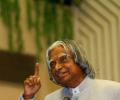
People like Dr Kalam teach us to dream and to chase our dreams. It is their humility that they wore on their sleeves that makes them truly great people. While we weep for a true Ratna that has left us on Monday, let us be happy that we lived in a period when he was alive and with us, says Rediff.com reader M C Sujil Bose.
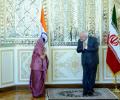
India's low passion, very cautious, relationship with Iran of the last 36 years awaits transformation, says Lieutenant General Syed Ata Hasnain (retd). Prime Minister Modi's visit cannot be a negotiating event; it is a symbolic one to strengthen the politico-diplomatic relationship.

'Modi is a symbol of Asia Rising; and, for the first time in decades, a non-white has the potential to be the most compelling global leader.'

'One of R&AW's greatest achievements is in projecting itself as benign.' 'This work -- done in tandem with the Diaspora and the MEA -- sells a story of India as mostly the victim.'

After all the drama that preceded the book launch of former Pakistani foreign minister Khurshid Mahmud Kasuri's book launch, the discussion that ensued on the book the same evening turned out to be a fiasco. Here's why

'It was China's rise that caused the New Cold War in Asia as it prompted the United States to rebalance its forces in Asia to experiment with engagement and containment at the same time,' says T P Sreenivasan.

Ambassador Natarajan Krishnan and Ambassador Shankar Bajpai helped shape Indian foreign policy at a glorious, but difficult, time in history, recalls Ambassador T P Sreenivasan.

'The youth associated with this movement were extremely talented.' 'But I personally believe violence cannot change anything in the world.'

'There is much symbolism in President Pranab Mukherjee's participation in the Victory Day celebrations in Moscow.'

'His secularism merely declared the equality of all religions in India under fundamental rights.'

'Like Nehru, too, Modi has found dealing with Beijing more and more difficult and has adopted an increasingly assertive approach towards managing India's northern neighbour.'
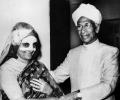
'She was once asked what the secret to political leadership was and she said it was the ability to like all kinds of people.' 'I don't think Rahul fundamentally likes people -- that's probably why he can't deal with them and it shows.' 'Sonia is a more talented political mobiliser than her son, but I think the decline of the Congress set in in 1969...'

Has New Delhi internalised the truth that it does not matter, asks Saeed Naqvi. Such deafening silence from the government, principal opposition, even the pundits!

'To consider BRICS anything more than a temporary club with some common interests would be folly. The goal should be to induce others (Japan, ASEAN, South Africa) to align with us -- a non-threatening, democratic nation, rather than with malevolent China or waning America. For us to consider aligning with either China or the US would be absurd. India is just too big to be a sidekick,' says Rajeev Srinivasan.

'India was in no position to wage another war in 1965, having suffered a morale-shattering defeat in 1962. The three services were in the middle of a modernisation and expansion phase and therefore not fully trained or battle-ready.'

Minister for External Affairs Salman Khurshid speaks about the importance of the fourth edition of the India-US Strategic Dialogue, which he co-chaired with United States Secretary of State John Kerry in New Delhi
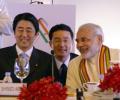
'Both nations have a common problem: A rampaging, jingoistic and hostile China which is making substantial territorial claims. In the long run, Japan and India are going to be the victims of Chinese aggression -- so they might as well hang together to contain China,' argues Rajeev Srinivasan.

'One big problem for the RSS is, while they spread their ideology of hard, Hindu-ised Indian nationalism, the absence of their own pantheon of modern nationalist giants. They missed out on the freedom movement quite comprehensively, in some ways comparable to the Muslim League and latter-day Communists. They have to find heroes elsewhere.' 'They borrow who they can from the Congress, like Madan Mohan Malviya and Sardar Patel, and then steal the entire lot of revolutionaries, from Bhagat Singh to Netaji, never mind that many of them were extreme leftists.'

'We saw how vigorous democracy was when it dislodged authoritarianism under Indira Gandhi. We saw its vigour again when it voted Mr Modi out of humble origins as prime minister. It was Nehru who laid that foundation for India and what is worrying today is Modi's rather imperial style of functioning,' says writer Nayantara Sahgal.

Trade between India and Indonesia stands at $20 billion.

A new West Asia is emerging and India must engage at the highest level and help shape this change, says Saeed Naqvi

'The creation of Pakistan was integral to Britain's grand strategy.' 'If they were to ever leave India, Britain's military planners had made it clear that they needed to retain a foothold in the NWFP and Baluchistan because that would provide the means to retain control of Iran, Iraq, Kuwait, the UAE, Bahrain and Qatar.'

'It was a mission undertaken in darkness in every sense -- literally, because Afghanistan had no electricity at that time; and, metaphorically because Delhi historically dealt only with the Pashtuns of Afghanistan and the foreign ministry's vast archives had nothing to offer on the culture and politics of the northern tribes in the Hindu Kush.'
